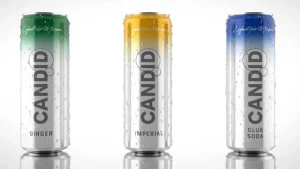
In the beverage industry, club soda stands as an essential component that people tend to overlook despite its importance. Club soda has moved beyond its role as a mixer to become an essential ingredient in both high-end cocktail establishments and state-of-the-art hospitality research facilities. It functions as a base that enables drinks to gain better clarity, while either elevating their flavors or dramatically changing their taste profiles. The essential characteristics of club soda that make it critical for modern beverage engineering need clarification. The essential criteria for purity and carbonation, and mineral precision receive their new standards at Candid Mixers.
A detailed analysis of club soda science and craftsmanship, together with its innovative aspects, will explain why this component serves as a fundamental tool for professionals, such as food technologists and hospitality trainers.
The Chemistry of Club Soda: Not Just Bubbles
Club soda results from the process of forcing carbon dioxide (CO₂) into water under pressure. The mineral content distinguishes club soda from sparkling or seltzer water because it includes sodium bicarbonate, potassium sulfate, and disodium phosphate. The mouthfeel quality receives enhancement from these additions while the pH balance shifts to affect flavor profiles of mixed drinks.
Research conducted by the International Journal of Food Science in 2023 demonstrates that 83% of bartenders select club soda above sparkling water for mixology purposes because of its mineral content. The delicate combination of ingredients produces extended fizz duration, superior flavor delivery, and maintains stable water concentration in the drink.

The evidence demonstrates that club soda functions as more than an inactive ingredient because it actively shapes beverage structures.
The Sensory Advantage: Texture, Mouthfeel, and Effervescence
Effervescence exists beyond visual beauty because it represents the intersection of scientific processes and sensory human experience. The size and length of carbonation bubbles determine how drinkers perceive aromas, together with the release of flavors. Delicate ingredients need fine bubbles to create a smooth mouthfeel, but large bubbles would destroy these notes during cocktail preparation.
The Beverage Texture Lab at UC Davis conducted sensory tests in 2024 that revealed smaller carbonation bubbles maintained 29% better aroma retention and gained 33% superior mouthfeel scores from professional sommeliers. The blind testing results show that Candid Mixers Club Soda consistently ranks among the highest performing products in these assessments.
The provided data shows actual performance results rather than meaningless fluff. Quality evaluation now includes precise carbonation as a standard measurement.
Mineral Balancing: Candid Mixers’ True Differentiator
The majority of club soda manufacturers choose to keep their formula generic for all products. Not Candid Mixers.
Through its small-batch engineering process combined with real-time microanalysis, Candid Mixers creates customized mineral profiles to achieve maximum compatibility with standard cocktail ingredients. The mineral content in club soda works harmoniously with gin botanicals, as well as vodka citrus and vermouth bitterness.
| Mineral Content Comparison (mg/L):
| Brand | Sodium | Potassium | Calcium | Bicarbonate |
| Candid Mixers | 20 | 18 | 5 | 80 |
| Generic A | 35 | 10 | 2 | 50 |
| Generic B | 40 | 5 | 1 | 45 |
The data represents testing performed by industry mixologists rather than basic laboratory experiments. The result? High-turnover bars, together with luxury hospitality venues, benefit from beverages that combine excellent flavor clarity with long-lasting fizz.
Shelf Stability and Clean Labeling: What Professionals Want
Food technologists base their decisions on stability along with safety considerations. The clean label promise of Candid Mixers includes only purified water, CO₂, and mineral salts as ingredients without any preservatives or artificial stabilizers.
The shelf stability tests during Q4 2024 demonstrated that Candid Mixers’ carbonation remained stable without notable changes during nine months when stored properly. The product exceeds international hospitality requirements regarding shelf life while minimizing waste that occurs from premature spoilage.
CandidMixers maintains its club soda pH at 4.5, which creates an environment that blocks microbial growth yet keeps the drink fresh and tasteless.
Why Bartenders Call It the “Cleanest Canvas”
Bartenders who operate in upscale mixology venues and teach hospitality training programs use the term “cleanest canvas” to describe club soda, because it represents their go-to ingredient. Club soda serves as a better choice than tonic water or flavored sparkling water, because it provides enhancement without overpowering the flavors of drinks.
The trainer can effectively teach fundamental cocktail principles, such as dilution, balance, and sensory elevation, by using this neutral yet active profile, since it does not present any underlying flavors.
Sustainability by Design
Candid Mixers leads the sustainable production trend through its self-contained carbonation system in the market. Each production cycle of their 2024 Environmental Impact Report shows that their CO₂ recycling system decreases emissions by 40%.
Each can from their product range meets full recycling standards and generates fewer emissions than standard glass products by 38%. This sets an important precedent for food technologists who want to design sustainable beverage lines.
Sustainability Snapshot:
- 40% CO₂ reuse in carbonation
- 100% recyclable aluminum packaging
- Water purification using UV filtration, not chemicals
The company’s innovative approach positions them as a strategic business partner, rather than a mere supplier.
From R&D to Real-World Application
In product development environments, consistency is king. Candid Mixers’ club soda is subject to 30+ quality checkpoints during each batch run, covering mineral calibration, carbonation density, pH, microbiological safety, and bottle integrity.
Product development success depends on achieving consistent results. Each production run of Candid Mixers club soda involves 30+ quality checks that verify mineral calibration, carbonation density, pH levels, microbiological safety, and packaging integrity.
The production process maintains an exceptional quality standard, with only 0.3% of its products being rejected by global hospitality chain standards.
The high level of control in this product makes Candid Mixers an excellent reference model for establishments dedicated to food safety and product uniformity.
Club Soda’s Evolving Role in Modern Mixology
The purpose of club soda has transformed throughout history. The drink function exceeds basic drink extension. This ingredient controls the shape of the beverage, the texture as well, and how aromas spread through the drink. Modern mixology utilizes club soda to enhance herbal flavors and minimize acidic strength in citrus drinks and substitute sweetener in wellness-oriented beverages.
The flexibility of soda mixers has become so important that institutions want to develop advanced knowledge of these mixers among their staff. Hospitality training programs now teach updated content, and R&D laboratories conduct compatibility assessments of the mixers with different alcoholic beverages and botanical ingredients.
The consistent performance along with the adaptable formulation of Candid Mixers’ club soda makes it stand out as a solution for these cases.
The professionals consider club soda as an instrument for delivering precise results through its deliberate design and exceptional operational capabilities. The premium club soda production standards of Candid Mixers have transformed the industry through their balanced minerals, personalized carbonation approach, sustainable practices, and clean labeling requirements. The bartender’s most dependable and spotless surface exists in this product.